




By Alex Antsyferov, Broker, and the AA Properties team | CENTURY 21 Leading Edge Realty Inc., Brokerage, Whitby
Short answer: Buy first or sell first? Selling first gives you a firm budget and no risk of carrying two homes, but you may need short-term housing. Buying first secures the next home but can leave you with two mortgages. Bridge financing and sale-of-property conditions can help, but each has costs and limits.
Moving up from a starter home in Pickering, or out to more space in Claremont or Whitby, means juggling two deals at once. Here’s how I walk sellers through the timing, so the move feels planned instead of rushed.

Should you sell first?
In my view, selling first is usually the lower-risk path. Once your sale is firm, you know what you have to spend, and you won’t be carrying two homes.
The trade-off is timing. If you don’t find the next home before closing, you may need a longer closing date, a short-term rental or a stay with family. A longer closing can be something to ask for when you negotiate your sale.
Should you buy first?
Buying first means you lock in the home you want. The risk is that your current home takes longer to sell, or sells for less, than you planned. Then you could be carrying two properties.
In September 2026, Pickering had 3.7 months of inventory and listings averaged 33 days on market (TRREB listing DOM), according to TRREB’s Market Watch. When buyers have choice, I’m careful about buying first without a solid plan for the sale.
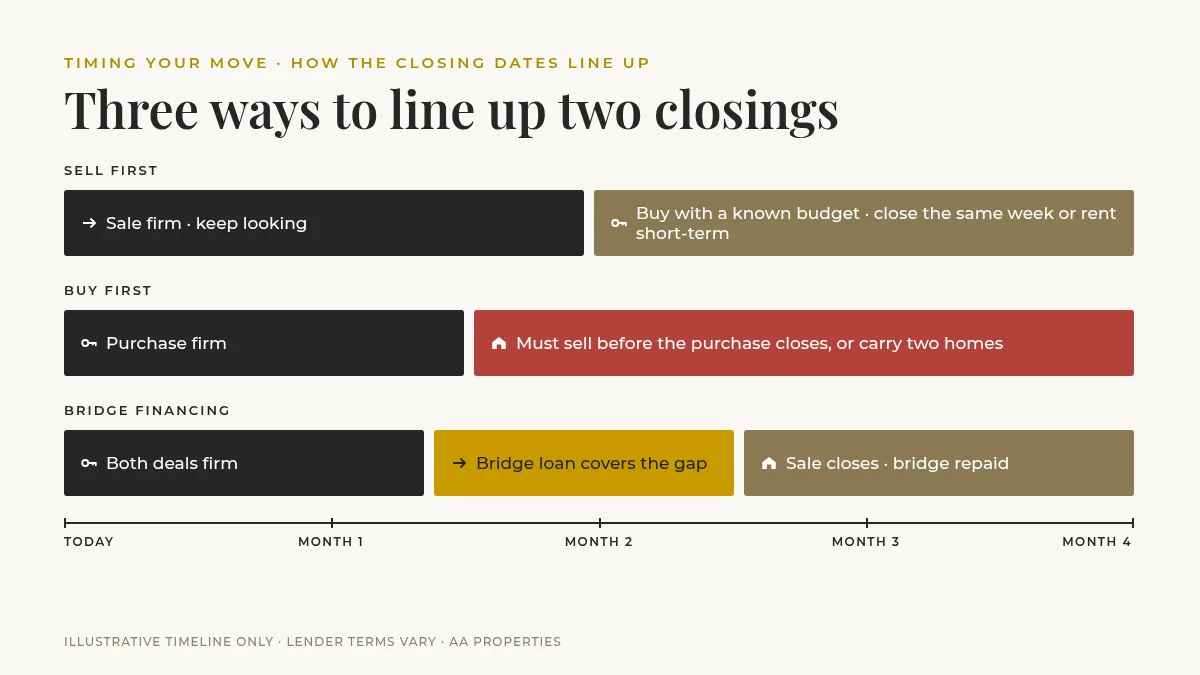
What is bridge financing?
A bridge loan is short-term financing that lets you use the equity in your current home toward the next one, usually for the down payment, while you wait for your sale to close. Here’s what two big Canadian banks say:
- RBC says bridge loan terms are typically six months but can range from 90 days to 12 months or longer, and a firm sale agreement must be in place on your existing home.
- TD says bridge financing typically lets you carry two mortgages for up to 90 days, and you’ll need both the sale and purchase agreements.
Both banks note the cost. RBC says interest can be more expensive than conventional financing, and TD says rates are similar to open-rate mortgages. The key point: a bridge loan usually needs a firm sale, so it covers a gap between closing dates. It doesn’t help if your home hasn’t sold yet. Ask your lender or mortgage broker what they’ll approve before you write an offer.
What is a sale-of-property condition?
You can make your purchase conditional on selling your current home. The seller usually keeps marketing their home, and the agreement often includes an escape clause. If the seller gets another offer they want to pursue, they give you notice, and you have a set window to waive your conditions or the deal can end as the agreement sets out.
According to Ontario real estate lawyers at LD Law, there’s no rule that every notice period is 48 hours. The window, delivery method and outcome depend on the agreement’s wording, so have your lawyer review it. In a balanced market, some sellers will consider a conditional offer. In a competitive one, many won’t.
What does the math look like?
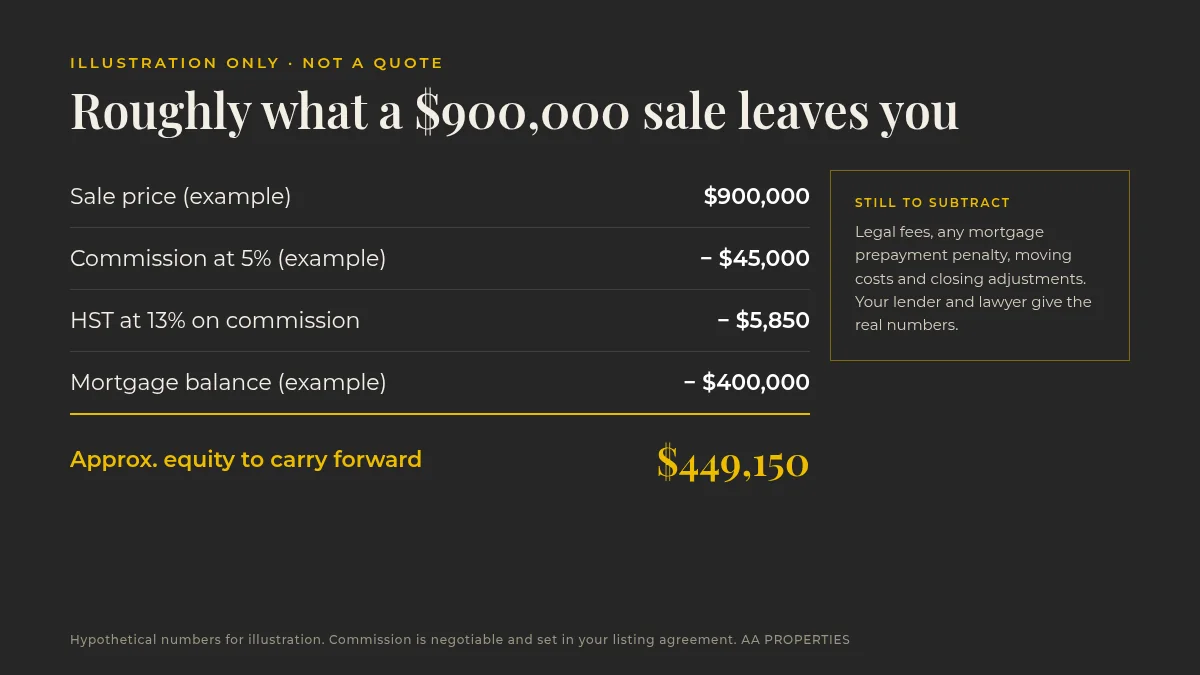
Illustration only. Say you sell for $900,000 with a $400,000 mortgage. At an example commission of 5% (an illustration, not our rate; commission is negotiable and set in your listing agreement), that’s $45,000, plus 13% HST of $5,850. That leaves about $449,150 before legal fees, any mortgage prepayment penalty, moving costs and adjustments. That’s roughly the equity a lender would look at for a bridge loan or your next down payment.
How I’d plan a move-up
- Get pre-approved for the next home, and ask your lender about bridge financing at the same time.
- Know your home’s value and your net. Our home value guide and seller closing costs guide help.
- Decide which matters more: certainty of price (sell first) or certainty of the home (buy first).
- Set closing dates with a buffer of a few days, if your lender agrees.
- Have your lawyer review any sale-of-property condition before you sign.
The same choices apply if you’re moving between Durham and Toronto or York Region. The difference is usually in prices and how fast each market is moving, so we plan around both.
Who we help: sellers and buyers across Durham Region, from Pickering and Claremont to Ajax and Whitby, plus Toronto, York Region and the rest of the GTA.
Related reading
Planning a move-up?
Book a free consultation. We’ll map out your timing, your numbers and which order makes sense for your family.
Book a free consultationPrefer to talk it through first? Call me at 416-845-8433, email alex@aaproperties.ca, or start with a free home value.
Nurse, police officer or firefighter? Our Everyday Heroes program offers 25% of the commission AA Properties earns, paid on closing, anywhere in Ontario, whether you’re buying or selling. Live in or moving to Durham Region? Good Neighbours offers 10% of the commission AA Properties earns, on a purchase or sale. Conditions apply: cash back is paid by CENTURY 21 Leading Edge Realty Inc., Brokerage, on a completed purchase or sale where we represent you under a signed agreement. Details on the program pages.
Frequently asked questions
Is it better to buy first or sell first?
For most move-up sellers, selling first is lower risk because you know your budget and won’t carry two homes. Buying first can make sense when you’ve found the right home and have financing to cover a gap.
How long can a bridge loan last?
It depends on the lender. RBC says terms are typically six months but can range from 90 days to 12 months or longer. TD says bridge financing typically covers up to 90 days.
Can I get a bridge loan before my house sells?
Usually not. RBC says a firm sale agreement must be in place on your existing home, and TD asks for both the sale and purchase agreements. Ask your lender what they’ll approve.
What is an escape clause in a conditional offer?
It lets the seller keep marketing while your offer is conditional on selling your home. If they get another offer, you have a set window to waive your conditions. The terms depend on the agreement, so have your lawyer review it.
The information in this blog is deemed accurate but not guaranteed. It’s for general purposes only and isn’t legal, financial or tax advice.

Stay Up-To-Date With AA Properties
You’re more than a client to us, you’re a valued part of our inner circle. To get the most recent market news, see our latest listing, and get our newest blogs in your inbox each month, sign up to our newsletter.