



By Alex Antsyferov, Broker, and the AA Properties team | CENTURY 21 Leading Edge Realty Inc., Brokerage, Whitby
Short answer: The three things Durham homeowners most often forget are the dryer vent duct (clean it at least once a year), the furnace filter and humidifier (check the filter every month in heating season and clean the humidifier two or three times a winter) and the sump pump (test it every fall and before spring thaw). Each takes under an hour, protects against fire, a struggling furnace or flooding, and shows up in home inspections when you sell.
Most homeowners remember the smoke alarms. These three hide in the laundry room, at the furnace and in a basement corner, so they get skipped for years. Then a home inspector finds them the week you’re trying to sell. Here’s how to look after each one in about an hour.
1. The dryer vent duct, not just the lint screen
Most people clean the lint screen. Far fewer clean the duct behind the dryer and the vent on the outside wall. Ontario’s Office of the Fire Marshal says many home fires happen because a dryer wasn’t cleaned or maintained, and it calls lint buildup a major fire risk (Ontario Fire Safety Guidebook: dryer fire safety).
How to do it:
- Clean the lint screen after every load.
- Unplug the dryer, pull it out (leave gas dryers to a pro) and disconnect the duct.
- Vacuum or brush the lint out of the duct and the dryer’s outlet. A dryer vent brush kit from a hardware store reaches long runs.
- Reconnect the duct, plug the dryer back in, then go outside with the dryer running and check that the exterior flap opens freely and isn’t blocked by lint, a nest or, in winter, ice and snow.
- Replace any plastic or foil duct. The province recommends metal ducting and the shortest, straightest path outdoors.
How often: the duct at least once a year, or sooner if clothes are taking longer than normal to dry. Call a pro if the duct runs a long way through a ceiling or wall, if you can’t reach the exterior vent safely, or for any gas dryer service. A gas or propane dryer also means a carbon monoxide alarm on every storey and outside sleeping areas, per the same provincial guide.
2. The furnace filter and humidifier
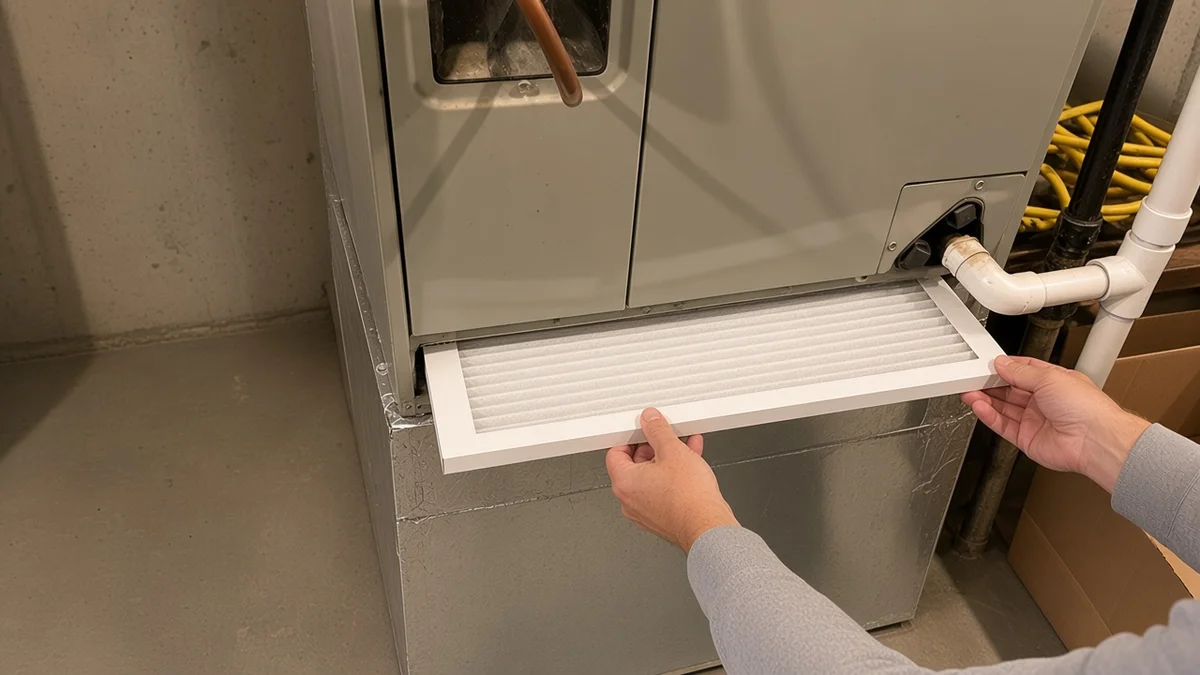
The filter is cheap and easy to look after, and it’s the one many people forget once the heat is on. CMHC’s Home Maintenance Schedule says to check and clean or replace furnace air filters each month during the heating season, and to clean a humidifier two or three times during the winter. In spring, it says to shut down, drain and clean a furnace humidifier, and close the furnace humidifier damper on units with central air conditioning (CMHC Home Maintenance Schedule). Enbridge Gas notes that a dirty filter restricts airflow, forcing the furnace to work harder and increasing natural gas use (Enbridge Gas: natural gas appliance safety).
How to do it:
- Turn the furnace off at its power switch before you open the filter compartment.
- Slide out the old filter. If it’s dirty, vacuum a reusable one and let it dry completely, or replace a disposable one.
- Slide the new or cleaned filter in with the arrow on the frame pointing toward the furnace (the airflow direction). Close the compartment and switch the furnace back on.
- If you have a furnace humidifier, clean it two or three times during the winter, following the manufacturer’s instructions.
- In spring, shut it down, drain and clean it, and close its damper if you have central air conditioning.
How often: check the filter every month while the heat is on, and clean or replace it when it’s dirty. Clean the humidifier two or three times a winter. Call a pro if the filter clogs again within days, if you smell burning dust that doesn’t clear, or for any gas work. CMHC recommends a qualified service company every two years for a gas furnace and every year for an oil furnace, or as your manufacturer’s manual says.
3. The sump pump (and where its water goes)
Plenty of Durham homes have a sump pit in a basement corner that nobody looks at until the spring melt. The City of Pickering lists sump pump failure, poor lot grading and blocked or overflowing eavestroughs among the causes of basement flooding, and it notes that some homes built before 1983 may have foundation drains connected to the sanitary sewer (City of Pickering basement flooding information). CMHC’s seasonal checklist includes checking the sump pump and its line every fall (CMHC Home Maintenance Schedule).
How to do it:
- Lift the lid and clear any debris from the pit.
- Slowly pour a pail of water into the pit. The float should rise, the pump should start, and the water should drain away quickly before the pump shuts off.
- Follow the discharge pipe outside and make sure it’s clear and not frozen or crushed.
- Check where it drains. Pickering’s Property Standards By-law 7887/21 requires sump pumps and downspouts to drain onto your own property (City of Pickering drainage and grading), and the City suggests running disconnected downspouts at least 1.2 m away from basement walls.
- While you’re outside, clear the eavestroughs and make sure downspouts carry water away from the foundation.
How often: test it every fall and again before the spring thaw, and after any big storm. Call a pro if the pump hums but won’t pump, cycles constantly, or is getting old. A licensed plumber can also talk to you about a battery backup, a high-water alarm and a backwater valve. The Institute for Catastrophic Loss Reduction recommends that sump systems have backup power and alarms (ICLR foundation drainage guidance). A backwater valve may need a building permit, so check with your municipality first.
Bonus tip: HRV filters and core
Many newer homes in Durham also have a heat recovery ventilator (HRV), the white box near the furnace that swaps stale indoor air for fresh outdoor air. Plenty of owners don’t know it’s there, or that it has filters. CMHC says clogged filters lower ventilation efficiency and recommends cleaning or replacing them every two months (CMHC: How to maintain a heat recovery ventilator). Natural Resources Canada adds that a neglected HRV in an airtight home can lead to poor indoor air quality and moisture problems, and it recommends checking the heat-exchange core twice a year and booking an annual service visit by a trained contractor (NRCan HRV guide). CMHC’s HRV and ERV guide recommends a contractor accredited by HRAI or TECA.
How often: filters every two months, the core twice a year, and the outdoor hoods more often in fall and winter. Turn the unit off before you open it, and follow your owner’s manual when you clean the core.
Why this matters when you sell
Buyers in Pickering, Ajax and Whitby almost always make a home inspection part of their offer or do one before an offer date. A lint-packed dryer duct, a filthy furnace filter or a sump pump that won’t start are exactly the kind of small items that end up on an inspection report and make a buyer wonder what else was skipped.
Keep a simple log with dates and receipts for each task. When you list, that log tells buyers the home has been looked after. Our fall home prep checklist for Durham sellers covers the rest of the house, and which renovations pay off before selling in Pickering helps you decide what’s worth fixing. Curious what a well-kept home is worth today? Start with our home value page.
If you’re in Claremont or rural north Pickering, add the well and septic system to your list. Our well and septic guide explains what to check.
Who we help: homeowners, buyers and sellers across Durham Region, from Pickering and Claremont to Ajax, Whitby and Oshawa, plus Toronto, York Region and the rest of the GTA and Ontario.
Related reading
Thinking about selling in the next year?
Book a free consultation. We’ll walk through what buyers and inspectors will notice and what’s worth doing before you list.
Book a free consultationPrefer to talk it through first? Call me at 416-845-8433 or email alex@aaproperties.ca.
Nurse, teacher, first responder or 60+? Our Everyday Heroes program offers 25% of the commission AA Properties earns, paid on closing, anywhere in Ontario. Buying or selling in Durham Region? Good Neighbours offers 10% of the commission AA Properties earns, paid on closing. Conditions apply: cash back is paid by CENTURY 21 Leading Edge Realty Inc., Brokerage, on a completed purchase or sale where we represent you under a signed agreement, and it can’t be combined with other offers. Details on the program pages.
Frequently asked questions
How often should I clean my dryer vent?
Clean the lint screen after every load and the vent duct at least once a year, or sooner if clothes take longer than normal to dry, as Ontario’s fire safety guidance recommends.
How often should I check my furnace filter and humidifier?
CMHC’s Home Maintenance Schedule says to check and clean or replace furnace air filters each month during the heating season, and to clean a humidifier two or three times during the winter. In spring, shut down, drain and clean a furnace humidifier and close its damper if you have central air. Follow your manufacturer’s manual, and have a gas furnace serviced every two years (oil: every year), or as the manual says.
How do I test my sump pump?
Slowly pour a pail of water into the sump pit. The float should rise, the pump should start and drain the pit, then shut off. Check that the discharge pipe outside is clear. Test it every fall and before the spring thaw.
Where can my sump pump drain in Pickering?
Under Pickering’s Property Standards By-law 7887/21, sump pumps and downspouts must drain onto your own property. The City also suggests running disconnected downspouts at least 1.2 m away from basement walls.
Will a home inspector check these items?
Inspectors commonly look at the dryer vent, furnace, sump pump and ventilation equipment. Keeping dated receipts and a maintenance log helps show buyers the home has been cared for.
The information in this blog is deemed accurate but not guaranteed. It’s for general purposes only and isn’t legal, financial or tax advice.

Stay Up-To-Date With AA Properties
You’re more than a client to us, you’re a valued part of our inner circle. To get the most recent market news, see our latest listing, and get our newest blogs in your inbox each month, sign up to our newsletter.